

Work Happiness: From Data Desks to Meaningful Farm Life
Summary: This is a personal account of leaving a desk-based career built around data, reports, and spreadsheets to build a small farm in southwest Khanh Hoa, Vietnam. It is not a blueprint for quitting your job. It is an honest look at what that transition involved — the childhood memory that planted the idea, the difficult early period, the meaning found in small things, and a practical framework for anyone weighing a similar change.
When the Spreadsheet Stops Making Sense
For years, my work centered on data, reports, paperwork, and spreadsheets. Over time, I began asking whether I wanted to spend the rest of my working life in that pattern. The question was not whether desk work lacked value; it was whether it matched the kind of life and work I wanted for myself.
Dissatisfaction with a job is not, by itself, a reason to leave. It is a reason to examine what feels missing, what responsibilities must be protected, and which alternatives can be tested before making a major change. For me, that reflection kept returning to gardening and the direct experience of helping something grow.
A Memory That Kept Returning
The answer, when it came, was not dramatic. It was a memory — the kind that surfaces quietly and then refuses to leave.
I remembered tending vegetable patches in my grandparents' garden as a child and the satisfaction of watching something grow. That memory gave me a concrete reference point when I began considering a different kind of work.
The memory did not become a plan overnight. It simply helped clarify why farming continued to feel worth exploring.
The Decision Was Not Simple
I want to be direct about this, because a lot of writing about career change glosses over the difficulty of the decision itself. Leaving stable desk work to build a small farm is not a decision that makes obvious sense on paper. It involves real financial risk, a steep learning curve, and the near-certainty of failure in the early stages.
For readers considering a similar change, a safer decision framework includes the following steps:
1. Test the Interest Before You Commit
Before making any structural change, spend time actually doing the thing you think you want to do. Gardening as a weekend activity is not the same as farming as a livelihood. The gap between interest and vocation is real, and it is worth discovering that gap before you have reorganized your life around an assumption.
2. Assess Your Financial Position Honestly
What are your fixed obligations? How long could you sustain yourself without income from the new direction? What is the realistic timeline before the new work becomes financially viable — if it ever does? These are not questions designed to discourage change. They are questions designed to make change survivable.
3. Build Skills Before You Need Them
Whatever the new direction is, there is almost certainly a body of knowledge attached to it that you do not yet have. Farming involves soil science, water management, pest control, seasonal planning, and a dozen other disciplines that take years to develop. Starting to learn before you make the transition reduces the steepness of the curve you will face afterward.
4. Define What Meaningful Work Actually Means to You
This is harder than it sounds. "Meaningful" is a word that gets used loosely. It is worth being specific: meaningful in what way? To whom? Over what time horizon? The clearer you can be about this, the better equipped you are to evaluate whether a particular change is likely to deliver it.
5. Expect Setbacks and Plan for Them
The first harvest will probably fail. The weather will not cooperate. The learning curve will be steeper than you anticipated. None of this means the direction is wrong. It means the direction is real, and real things are difficult. Building in the expectation of setbacks — financially, emotionally, practically — is not pessimism. It is preparation.
Before and After: An Honest Comparison
| Dimension | Desk Work in This Story | Farm Work in This Story |
|---|---|---|
| Daily focus | Data, reports, paperwork, and spreadsheets | Plants, weather, harvests, and practical tasks |
| Visible output | Information and reports | Seedlings and produce |
| Learning | Existing professional routines | A new and difficult learning curve |
| Planning needs | Responsibilities still require review | Results can be uncertain, especially at the start |
| Connection to nature | Limited during screen-based work | Part of everyday work |
| Meaning | Felt increasingly distant to the author | Felt more direct, but did not remove difficulty |
This table is not an argument for one over the other. It is an attempt to be honest about what each involves. The farm column is not uniformly better. It is different, and for some people — not all — that difference is worth the cost.
The Early Period Was Hard
The first harvest failed. Learning the practical work of farming, responding to harsh weather, and understanding what the land required took time. The failure was discouraging, but it also became part of the learning process.
Two experiences made the change feel worthwhile to me: watching a seedling sprout and eating produce grown on the farm. Those moments did not erase the difficult work. They simply provided the direct connection between effort and result that I had been missing.
Meaningful work is not automatically easy, comfortable, or financially secure. A career change should therefore be evaluated through responsibilities, resources, skills, and real experience—not through a romantic picture of another lifestyle.
What the Farm Road Looks Like
The farm road is in southwest Khanh Hoa, near Lam Dong. It passes through a local community, and rough terrain plus limited internet access affect travel and communication.
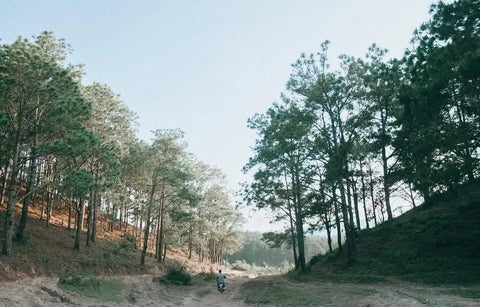
These conditions are practical constraints, not decorative details. They shape what can be done, how quickly problems can be solved, and how connected the farm is to outside services.
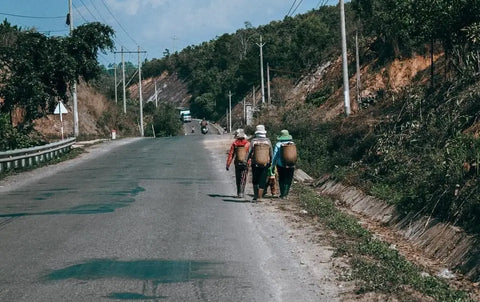
This description concerns the road and logistics only. The surrounding community should not be reduced to scenery for someone else’s personal story.
What Meaning Actually Looked Like
After years of working with data and producing reports, the experience of watching a seedling emerge from soil was genuinely surprising in its effect. Not because it was dramatic — it is not — but because it was legible. The connection between the attention you paid and the result you got was direct and visible in a way that most desk work is not.
Eating produce grown on the farm carried a similar quality. The satisfaction was not about self-sufficiency as an ideology. It was about the experience of having made something that was real and useful and connected to daily life in an immediate way.
Sustainable living, in this context, is not a brand position. It is a practical orientation — trying to use what is available, reduce what is wasted, and build something that can continue without constant external input. It is imperfect and ongoing, and it does not resolve into a clean conclusion.
Reflection Questions for Anyone Weighing a Similar Change
If you are questioning whether your current work fits the life you want, consider these questions:
- What kind of work have you done, even briefly, that felt genuinely connected to something you cared about?
- If you removed financial pressure from the equation entirely, what would you spend your time doing?
- What is the smallest version of the change you are considering that you could test without committing to it fully?
- What would you need to have in place — financially, practically, in terms of skills — before a larger change felt responsible rather than reckless?
- What does failure look like in the direction you are considering, and is it survivable?
These questions do not produce answers. They produce better questions, which is usually more useful.
Frequently Asked Questions
Is leaving a desk job to farm a realistic option for most people?
For most people, no — at least not in the form of a complete and immediate transition. The financial and practical barriers are real. What is realistic for more people is a gradual shift: testing the interest, building skills, reducing financial exposure, and moving incrementally toward work that feels more connected to what matters to them.
How do you know if dissatisfaction with your job is a signal to leave or just a temporary feeling?
Duration and specificity are useful indicators. A temporary feeling tends to be tied to a specific circumstance — a difficult project, a stressful period — and resolves when that circumstance changes. A more persistent dissatisfaction that remains even when circumstances improve, and that is connected to the nature of the work rather than its conditions, is worth taking more seriously.
What was the hardest part of the transition from desk work to farming?
The steepness of the learning curve, combined with the consequences of getting things wrong. In desk work, a mistake in a report is correctable. In farming, a mistake in timing or technique can mean a failed harvest — real loss, not just an error to be revised. That shift in the stakes of daily decisions was the adjustment that took the longest.
Does working closer to nature automatically lead to greater happiness or fulfillment?
No. The connection between environment and wellbeing is real but not automatic. Farm work is physically demanding, financially uncertain, and often isolating. What it offers is a different relationship to the work itself — more direct, more tangible, more connected to natural cycles. Whether that translates into fulfillment depends on the person and what they are looking for.
What would you tell someone who is interested in a similar change but feels it is too late or too risky?
The question of timing is real, and the question of risk is real. Neither is a reason not to explore the direction — they are reasons to explore it carefully. The smallest version of the change is almost always available: a weekend of actual farming, a course in soil science, a conversation with someone who has made a similar transition. Starting there costs very little and tells you a great deal.
A Note on What This Is and Is Not
This account is personal. It describes one transition, in one set of circumstances, with one outcome that is still unfolding. It is not a recommendation that you leave your job. It is not a claim that farming is better than desk work, or that rural life is more authentic than urban life, or that dissatisfaction is always a signal to make a dramatic change.
What it is, I hope, is an honest account of what one version of this kind of change actually involved — the difficulty, the meaning, the ongoing uncertainty — offered in the hope that it is useful to someone working through a similar question.
The farm road in southwest Khanh Hoa is rough and the internet is limited and the work is hard. It is also, for now, the right place to be. That is not a universal conclusion. It is just the one that is true here.
Related collection
Explore Related Collections
Browse culinary and botanical collections related to this topic.
Browse Ingredient CollectionsProducts and collections are presented for general ingredient, culinary, botanical, craft, or gardening use. Content on this site is educational only and is not medical advice.
Leave a comment