

Guava Leaf Tea Guide: Brewing, Uses, Research, and Safety
Guava leaf tea is an herbal infusion made by steeping the dried or fresh leaves of the guava tree (Psidium guajava) in hot water. It is caffeine-free, has an earthy, mildly astringent flavor with a faint fruity undertone, and has been used as a traditional beverage and folk remedy in tropical regions of Latin America, Southeast Asia, and Africa for generations. This guide explains what guava leaf tea is, how it differs from guava fruit, how to choose and prepare it, what the research does and does not support, and what safety considerations are worth knowing before using it regularly.
Guava Leaf Tea vs. Guava Fruit
Guava leaf tea and guava fruit are products of the same tree but are quite different in character. The fruit (Psidium guajava) is sweet, high in vitamin C, and eaten fresh or used in juices, jams, and desserts. The leaves are not eaten as food in most traditions; they are steeped in water to make an infusion. The flavor of the leaf infusion does not closely resemble the fruit — it is more herbal, earthy, and astringent, with only a faint background sweetness that hints at the plant's tropical origin.
Guava leaf extracts and supplements are also available and are more concentrated than brewed tea. This guide addresses brewed tea from dried or fresh leaves, not extracts or supplements, which have different concentration levels and risk profiles.
Flavor Profile
Guava leaf tea brews to a pale green or light amber color depending on the amount of leaf used and the steep time. The flavor is earthy and mildly astringent, with a clean, slightly woody character and a subtle fruity note in the background. It is less sharp than green tea and less bitter than some other herbal infusions. The astringency increases noticeably with longer steep times or higher leaf quantities. Most people find the flavor mild and approachable on its own, and it pairs well with honey, lemon, or ginger.
Sourcing and Choosing Dried Guava Leaves
Guava trees grow throughout tropical and subtropical regions, and dried guava leaves are available from herbal suppliers, Latin American grocery stores, and online retailers. When choosing a product, look for these indicators of quality:
- Botanical name on label — Psidium guajava confirms the correct species. Some products use common names only ("guava leaf," "hojas de guayaba"), which is generally fine but less traceable.
- Food-grade designation — look for products explicitly sold for culinary or tea use, not ornamental or agricultural purposes. Food-grade dried leaves should be clean, free of pesticide residue disclosures, and ideally tested or certified by the supplier.
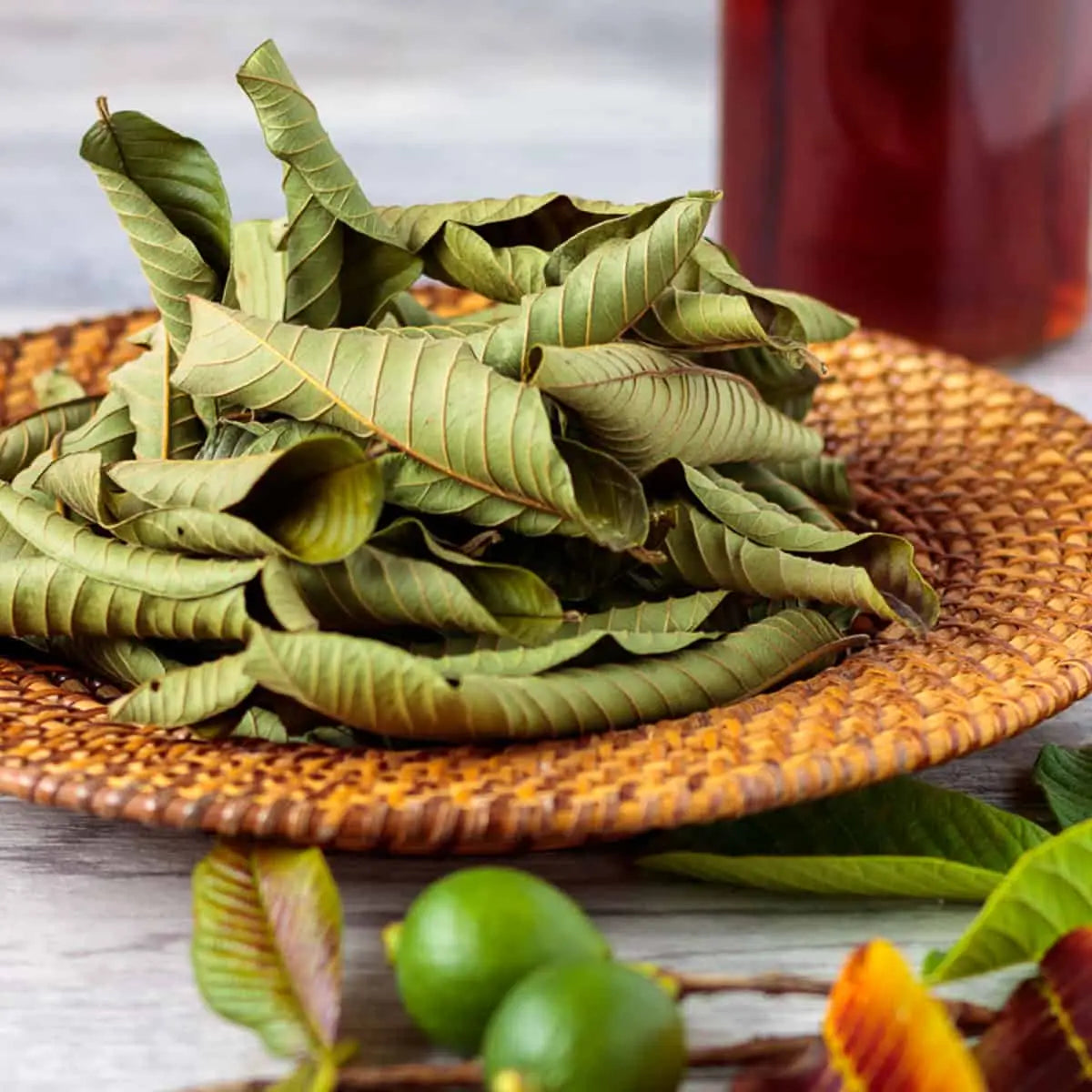
- Appearance — dried leaves should be intact or in large pieces, with a consistent green to olive-brown color. Excessive dust, very fine fragments, or an off smell suggest poor quality or age.
- Aroma — quality dried guava leaves have a mild, slightly grassy, faintly fruity scent. A musty or chemical smell is a red flag.
- Origin and harvest date — named origin (e.g., Mexico, Vietnam, Philippines) and a harvest or production date add transparency. Use the product date and storage guidance rather than assuming one shelf-life window for every package.
- Organic certification — not required, but useful for buyers who want to minimize pesticide exposure, since guava is grown in regions with varying agricultural standards.
Preparing Guava Leaves for Brewing
Using Dried Leaves
Dried guava leaves are the most convenient form for home brewing. They are shelf-stable, consistent in flavor, and easy to measure. No washing is required if the product is food-grade and packaged for tea use, though a quick rinse before steeping is a reasonable precaution if you prefer it.
Using Fresh Leaves
Fresh guava leaves can be used if you have access to a guava tree or a source of fresh culinary-grade leaves. Preparation steps for fresh leaves:
- Select — choose mature, undamaged leaves. Avoid leaves with visible spots, insect damage, or discoloration.
- Wash — rinse thoroughly under cold running water to remove surface dust, debris, and any residues. Pat dry or shake off excess water.
- Optional: lightly bruise — gently crushing or tearing the leaves before steeping helps release their compounds into the water more efficiently.
- Use promptly — fresh leaves are best used the same day. Store unwashed fresh leaves in the refrigerator for up to 2–3 days if needed.
Brewing Guava Leaf Tea
Step-by-Step Method
- Measure — use 1–2 teaspoons of dried leaves (or 3–5 fresh leaves) per 8 oz (240 ml) of water. Start at the lower end and adjust to taste.
- Heat water — bring filtered water to a full boil, 212°F (100°C). Guava leaves are robust and benefit from boiling water to extract their flavor fully.
- Steep — pour boiling water over the leaves and steep for 5–8 minutes. For a lighter cup, remove at 5 minutes. For a stronger, more astringent cup, steep up to 10 minutes. Covering the vessel during steeping is optional but helps retain heat.
- Strain — remove the leaves promptly after steeping. Leaving them in the water beyond the intended time increases astringency significantly.
- Taste and adjust — the liquor should be pale green to light amber with a mild earthy aroma. A small amount of honey softens the astringency. Fresh lemon juice or a slice of ginger adds brightness. The tea is also pleasant plain.
- Alternative: simmer method — for a stronger infusion, combine leaves and water in a small saucepan, bring to a gentle simmer, and simmer for 5–10 minutes before straining. This produces a more concentrated cup.
Brewing Quick Reference
| Variable | Dried Leaves | Fresh Leaves |
|---|---|---|
| Amount per 8 oz (240 ml) | 1–2 tsp | 3–5 leaves |
| Water temperature | 212°F / 100°C (boiling) | 212°F / 100°C (boiling) |
| Steep time | 5–8 minutes | 5–8 minutes |
| Color | Light amber to pale green | Pale green |
| Caffeine | None | None |
| Re-steep | Once, lighter | Generally not recommended |
Iced Guava Leaf Tea
Brew at double strength (double the leaves, same water volume), steep for the full 8 minutes, strain, and pour over ice to dilute to normal strength. The result is a refreshing, lightly astringent iced tea that pairs well with a squeeze of lime and a few mint leaves. Cold-brew guava leaf tea (leaves steeped in cold water for 8–12 hours in the refrigerator) produces a milder, smoother cup with less astringency.
Serving Ideas and Culinary Uses
Guava leaf tea is most commonly served as a plain hot or iced beverage. Beyond the cup, steeped guava leaf liquid can be used as a flavoring base in rice cooking (a traditional use in some Southeast Asian cuisines), as a liquid component in marinades for grilled meats, or as a base for herbal syrups. In some Latin American and Asian traditions, guava leaves are also used in cooking — added to pots of rice or beans to impart a mild herbal note. These are culinary applications of the leaf as a food ingredient, distinct from supplement or extract use.
Traditional and Cultural Context
Guava leaf preparations have a long history of traditional use in Mexico, Central America, Brazil, the Philippines, Japan, and parts of West Africa, among other regions. In many of these traditions, guava leaf tea or decoctions have been used for digestive complaints, wound care, and general wellness. This traditional use reflects generations of practical knowledge and cultural heritage. It does not, on its own, constitute clinical evidence of efficacy for specific conditions — traditional use and scientific evidence are different categories of knowledge, and this guide treats them as such.
What Research Shows — and What It Does Not
Guava leaves contain a range of plant compounds including quercetin, other flavonoids, tannins, and various polyphenols. These compounds have been studied in laboratory and animal settings, and a smaller number of human studies have examined guava leaf extracts. Understanding what the research actually shows requires distinguishing between types of evidence:
- Laboratory (in vitro) studies examine how compounds behave in isolated cells or test tubes. These findings are useful for generating hypotheses but do not tell us how brewed tea behaves in the human body.
- Animal studies test effects in rodents or other animals. Results do not reliably predict human outcomes.
- Human studies using extracts or supplements may use concentrated or standardized preparations that are not equivalent to a home-brewed cup. Their findings should not automatically be applied to ordinary guava leaf tea.
- Human studies using brewed tea are limited in number, generally small in sample size, and often short in duration. They do not provide sufficient evidence to support clinical claims.
Areas where preliminary research exists include blood glucose response, digestive function, and antimicrobial activity in laboratory settings. None of these areas has sufficient human clinical evidence to support claims that guava leaf tea treats, prevents, or manages any medical condition. Guava leaf tea is a beverage with a long traditional history — it is not a medicine, and it should not be used in place of medical care.
Storage
Store dried guava leaves in an opaque, airtight container away from direct light, heat, and strong odors. Follow the product’s best-before and storage guidance, and label the container with the purchase or opening date. Aroma and color are practical freshness checks. If the leaves have lost their mild earthy-fruity scent when you open the container, the tea will be flat. Fresh leaves should be used promptly or refrigerated for up to 2–3 days unwashed.
Caffeine and Suitability
Guava leaf tea is naturally caffeine-free because it is made from leaves of Psidium guajava, not from Camellia sinensis (the tea plant). It is suitable for people avoiding caffeine at any time of day, including in the evening. It is not suitable as a replacement for medical treatment of any condition.
Safety Notes
Small, short-term human studies have reported tolerability for specific guava-leaf preparations, but that does not establish a universal dose or the safety of long-term daily use. Product strength and individual circumstances vary.
- Limited long-term data — evidence for regular use of home-brewed guava leaf tea is limited, and concentrated extracts are not equivalent to an ordinary infusion.
- Pregnancy and breastfeeding — safety has not been adequately established. Ask a qualified healthcare professional before regular use.
- Medication questions — guava leaf products have been studied for physiological effects, while clinical interaction evidence remains limited. If you take medication or manage a health condition, ask a pharmacist or clinician before using the tea regularly or using concentrated products.
- Concentrated products — supplements, capsules, tinctures, and standardized extracts may deliver different amounts than brewed tea. Follow their labels and do not treat them as interchangeable with a culinary infusion.
- Children — seek pediatric guidance before giving herbal preparations regularly to a child.
Frequently Asked Questions
What does guava leaf tea taste like?
Guava leaf tea has a mild, earthy, slightly astringent flavor with a faint fruity undertone that hints at the guava plant's tropical origin. It is less sharp than green tea and less bitter than some other herbal infusions. The flavor becomes more astringent with longer steep times. Most people find it approachable plain, and it pairs well with honey, lemon, or ginger.
Is guava leaf tea the same as guava fruit tea?
No. Guava leaf tea is made from the leaves of the guava tree (Psidium guajava) and has an earthy, mildly astringent flavor. Guava fruit tea or guava-flavored tea is made from or flavored with the fruit, which is sweet and tropical. They come from the same plant but are very different products in flavor, preparation, and nutritional composition.
Can I drink guava leaf tea every day?
Research does not establish a universal daily amount or long-term safety for home-brewed guava leaf tea. Occasional culinary use is different from frequent use or concentrated extracts. Ask a clinician if you take medication, manage a health condition, are pregnant or breastfeeding, or plan regular use.
Does guava leaf tea have caffeine?
No. Guava leaf tea is naturally caffeine-free. It is made from the leaves of Psidium guajava, not from the tea plant (Camellia sinensis), so it does not add caffeine. Whether it suits a particular time of day still depends on the person and the rest of the blend.
Can I use fresh guava leaves instead of dried?
Yes. Fresh leaves can be used only when the plant is positively identified as edible guava, the leaves are clean and free from unsuitable pesticide treatments, and local food-safety guidance permits their use. Wash them thoroughly; a common starting method is 3–5 leaves per cup steeped in boiling water for 5–8 minutes. Fresh leaves produce a slightly greener, milder cup than dried leaves. Dried leaves are more convenient, consistent, and shelf-stable for everyday use.
Related collection
Explore Tea Collections
See tea selections and related pantry ingredients.
Browse Tea CollectionsProducts and collections are presented for general ingredient, culinary, botanical, craft, or gardening use. Content on this site is educational only and is not medical advice.
Leave a comment