

How Tea Is Made: From Fresh Leaves to a Finished Cup
All true teas—including black, green, white, oolong, and pu-erh—come from the same plant: Camellia sinensis. What makes each type distinct is not the plant itself but what happens to the leaf after it is picked. The production process is a precise sequence of steps — plucking, withering, rolling or shaping, oxidation or fixation, drying, and sorting — and the choices made at each stage determine the tea's color, aroma, flavor, and character. Understanding how tea is made helps you appreciate what is in your cup and why different teas taste so different from one another.
Growing Conditions and Cultivar
Camellia sinensis is an evergreen shrub native to Southwest China and Southeast Asia. It is now cultivated across a wide band of tropical and subtropical regions — from Assam and Darjeeling in India to Fujian and Yunnan in China, Sri Lanka, Kenya, Japan, and Taiwan. Growing conditions shape the raw material before any processing begins.
Key Factors in the Growing Environment
- Altitude: Higher-altitude gardens often experience cooler temperatures and slower leaf growth. Together with cultivar, season, soil, and production choices, these conditions can contribute to the aromatic character associated with many high-grown teas.
- Climate and rainfall: Tea requires consistent rainfall and humidity. Seasonal variation — dry and wet periods — creates distinct harvest windows (flushes) with different flavor profiles.
- Soil: Well-drained, slightly acidic soil with good organic content supports healthy root development and leaf quality.
- Cultivar: Two widely recognized botanical varieties are Camellia sinensis var. sinensis (generally smaller-leaf) and var. assamica (generally larger-leaf), alongside many cultivars selected for flavor, yield, climate tolerance, or disease resistance.
- Shade growing: Some Japanese teas (Gyokuro, Matcha) are shaded for 3–4 weeks before harvest. Reduced sunlight increases chlorophyll and L-theanine while decreasing catechins, producing a sweeter, more umami-rich leaf.
Plucking: Where Production Begins
Tea production starts at the moment of harvest. The standard for quality tea is the "two leaves and a bud" — the terminal bud and the two youngest leaves at the tip of each shoot. These young leaves contain the highest concentration of flavor compounds, polyphenols, and aromatic oils.
Plucking can be done by hand or by machine. Hand plucking is slower and more selective — skilled pluckers can assess each shoot individually and choose only the finest material. Machine harvesting is faster and more economical but less discriminating, often including older, coarser leaves. Premium teas are almost always hand-plucked.
The timing of harvest also matters. In regions with distinct seasons, the first flush (spring harvest) is typically the most prized — the plant has rested over winter and the new growth is tender and concentrated. Subsequent flushes (summer, autumn) have different and often bolder character.
Withering
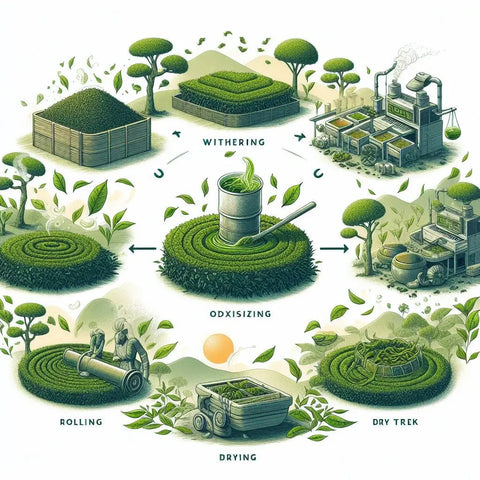
After plucking, fresh leaves are spread in thin layers on bamboo trays or wire mesh racks and exposed to warm, moving air for 12–18 hours. This step — called withering — reduces the moisture content of the leaf by roughly 50%, making it pliable and reducing the risk of tearing during rolling. Withering also begins the enzymatic activity that will drive oxidation in the next stages. The duration and conditions of withering (temperature, airflow, humidity) are carefully controlled and vary by tea type and factory.
Rolling and Shaping
Once withered, the leaves are rolled or shaped. This step serves two purposes: it gives the finished tea its physical form, and it breaks down the cell walls of the leaf, releasing enzymes and juices that initiate and accelerate oxidation.
Rolling can be done by hand (for artisan teas) or by machine using cylindrical rolling tables. The pressure and duration of rolling are adjusted depending on the desired outcome. For tightly rolled oolongs and some Chinese green teas, the leaves are shaped into balls or pellets. For orthodox black tea, the leaves are rolled into twisted strips. For CTC (Cut-Tear-Curl) black tea — a common format used in tea bags — the leaves are passed through a series of cylindrical rollers with sharp teeth that cut, tear, and curl the leaf into small, uniform granules. CTC produces a fast-brewing, strong, consistent cup suited to blending and tea bag production.
Oxidation: The Step That Defines Black and Oolong Tea
In standard tea-production terminology, oxidation and microbial fermentation are different processes. Oxidation is driven largely by enzymes in damaged tea leaves reacting with oxygen. Post-fermentation involves microbial activity and is intentionally used in pu-erh and other dark teas; it is not the defining process for black, green, white, or oolong tea.
After rolling, the leaf is spread in a cool, humid environment and left to oxidize. Enzymes (primarily polyphenol oxidase) react with oxygen to convert colorless catechins into theaflavins and thearubigins — the compounds responsible for black tea's dark color, amber liquor, and malty, robust flavor. The longer oxidation proceeds, the darker and more full-bodied the tea becomes.
- Black tea: allowed to oxidize substantially until the maker reaches the desired color and aroma; timing varies with leaf, temperature, humidity, and style
- Oolong tea: partially oxidized, with the extent managed through repeated bruising, resting, and heating to create styles ranging from light and floral to dark and roasted
- Green and white tea: oxidation is prevented or minimized (see Fixation below)
Fixation (Killing the Green): How Green Tea Stays Green
For green tea — and to a lesser extent white tea — oxidation must be halted immediately after rolling or even before it begins. This is achieved through a process called fixation, or "killing the green" (shaqing in Chinese). Heat is applied to denature the oxidative enzymes, locking the leaf in its green state and preserving the fresh, grassy, vegetal flavors characteristic of green tea.
There are two primary fixation methods, and they produce distinctly different flavor profiles:
- Pan-firing (Chinese style): Leaves are tossed in a large, dry wok or rotating drum over high heat. This produces a drier, slightly toasty, nutty character. Examples: Dragonwell (Longjing), Gunpowder green tea.
- Steaming (Japanese style): Leaves are briefly exposed to steam. This preserves more chlorophyll and produces a greener, more vegetal, umami-forward flavor. Examples: Sencha, Gyokuro, Matcha.
Drying and Firing
After oxidation (for black and oolong teas) or fixation (for green teas), the leaves must be dried to reduce moisture content to approximately 3–5%. This step — called drying or firing — halts all remaining enzymatic activity, stabilizes the leaf for storage and transport, and contributes additional flavor development through the Maillard reaction (the same browning chemistry that occurs when bread is toasted).
Drying methods include:
- Hot-air drying: The most common industrial method; leaves pass through a heated tunnel on a conveyor belt.
- Pan-firing: Used for some Chinese green and oolong teas; imparts a characteristic roasted note.
- Sun-drying: Traditional method for some white teas and pu-erh; slow and weather-dependent.
- Charcoal roasting: Used for some Taiwanese oolongs (Dong Ding) and Japanese Hojicha; produces a deep, smoky, caramelized character.
Sorting, Grading, and Quality Control
After drying, the finished tea is sorted by leaf size, shape, and quality using a series of mesh sieves and air separators. Larger, more intact leaves are graded higher; smaller broken pieces and dust are graded lower. In the orthodox black tea grading system, grades include Flowery Orange Pekoe (FOP), Orange Pekoe (OP), Broken Orange Pekoe (BOP), and Fannings — each indicating leaf size and intended use. Fannings and dust are the grades most commonly used in standard tea bags.
Quality control at this stage involves visual inspection, moisture testing, and cupping — the professional tasting process used to evaluate flavor, aroma, color, and consistency. Skilled tea tasters assess each batch against established standards before it is approved for packaging.
Specialty Production Pathways
Each major tea category follows a distinct production pathway. The table below summarizes the key differences.
| Tea Type | Withering | Fixation | Oxidation | Shaping | Drying Method |
|---|---|---|---|---|---|
| Black tea (orthodox) | Yes (heavy) | None | Full (2–4 hrs) | Rolling | Hot-air tunnel |
| Black tea (CTC) | Yes | None | Full (faster) | Cut-Tear-Curl machine | Hot-air tunnel |
| Green tea (Chinese) | Brief or none | Pan-firing | None | Rolling/shaping | Pan-firing or hot-air |
| Green tea (Japanese) | Brief or none | Steaming | None | Rolling/needling | Hot-air or rolling |
| White tea | Yes (long, slow) | Minimal | Minimal (natural) | None (buds left whole) | Sun or hot-air |
| Oolong tea | Yes | Yes (partial) | Partial (15–85%) | Rolling or ball-rolling | Hot-air or charcoal |
| Pu-erh (Sheng/raw) | Yes | Pan-firing | None initially | Compressed into cakes | Sun-dried; aged |
| Pu-erh (Shou/ripe) | Yes | Pan-firing | Microbial fermentation | Compressed or loose | Hot-air; aged |
Pu-erh Tea: The Role of True Fermentation
Pu-erh is a prominent post-fermented tea, and its microbial development should not be confused with the enzymatic oxidation used in black tea production. Sheng (raw) pu-erh is made from sun-dried tea material that may be compressed and aged; its character changes through slow chemical and microbial activity under suitable storage. Shou (ripe) pu-erh uses an accelerated wet-piling process (wo dui) to create a mature, dark profile in weeks or months. Shou does not simply duplicate decades-aged sheng—the two follow different production paths and can taste distinctly different.
Packaging and Storage After Production
Once sorted and approved, finished tea is packaged to protect it from the four main enemies of tea quality: light, moisture, heat, and oxygen. High-quality teas are typically sealed in foil-lined bags, airtight tins, or vacuum-sealed pouches. Some teas — particularly Japanese green teas — are nitrogen-flushed to displace oxygen and extend freshness. Pu-erh cakes are wrapped in paper and stored in conditions that allow continued slow aging.
At the consumer level, the same principles apply: store tea in an airtight container away from direct sunlight, heat sources, and strong odors. Most teas are best consumed within 12–18 months of production. Pu-erh is the notable exception — properly stored, it improves with age.
How Factory Production Differs from Home Brewing
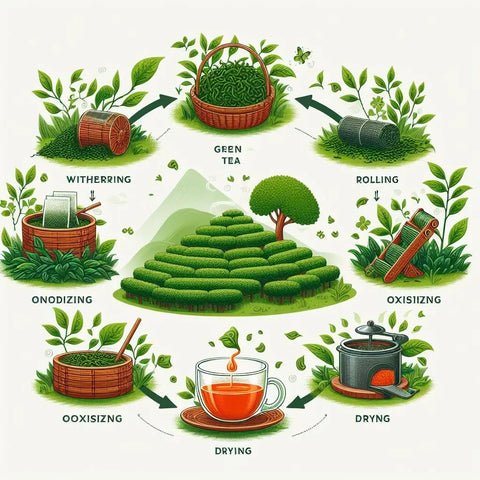
It is worth clarifying a common point of confusion: the production process described above — withering, rolling, oxidation, drying — happens at the farm or factory level, before the tea reaches you. When you brew tea at home, you are not making tea; you are extracting the compounds already locked into the finished, dried leaf by steeping it in hot water. The quality of your cup is determined partly by the production quality of the leaf and partly by your brewing variables — water temperature, steep time, and leaf quantity. No amount of careful home brewing can compensate for poorly produced tea, and excellent tea can be ruined by incorrect brewing.
Frequently Asked Questions
Is black tea fermented?
In modern technical usage, black tea is described as oxidized rather than intentionally fermented. Enzymes in the damaged leaf react with oxygen to create many of its color and flavor compounds. Microbial post-fermentation is a different production step associated with pu-erh and other dark teas.
Why does green tea taste so different from black tea if they come from the same plant?
Processing is the main distinction, while cultivar, origin, and harvest also shape flavor. Green tea is heated early to limit enzymatic oxidation, preserving a greener appearance and fresher flavor profile. Black tea is rolled or macerated and allowed to oxidize substantially, forming compounds such as theaflavins and thearubigins that contribute to its darker color and robust character.
What is the difference between orthodox and CTC tea production?
Orthodox production preserves the leaf structure through careful rolling, producing whole or large-leaf teas with complex, layered flavor. CTC (Cut-Tear-Curl) production passes the leaf through toothed rollers that shred it into small, uniform granules. CTC tea brews faster, stronger, and more consistently — it is the dominant format for tea bags and strong breakfast blends. Orthodox tea is generally preferred for loose leaf drinking where flavor complexity is the goal.
What does "first flush" mean?
A flush refers to a harvest period. The first flush is the first harvest of the growing season — typically spring — when the plant produces its first new growth after the dormant winter period. First-flush teas are often the most prized: the leaves are young, tender, and concentrated in flavor compounds. Subsequent flushes (second flush in summer, autumnal flush) have different and often bolder or earthier characters. The term is most commonly used for Darjeeling and Assam teas.
Does the production process affect caffeine content?
Yes, to some extent. The degree of oxidation, leaf grade, and shaping all influence how readily caffeine extracts during brewing. CTC-grade teas, with their small particle size, release caffeine very quickly. Whole-leaf teas extract more slowly. Shade-grown teas (Gyokuro, Matcha) tend to be higher in caffeine because shading increases amino acid and caffeine synthesis in the leaf. However, brewing variables — water temperature, steep time, and leaf quantity — have a larger practical effect on the caffeine in your cup than production method alone.
Related collection
Explore Tea Collections
See tea selections and related pantry ingredients.
Browse Tea CollectionsProducts and collections are presented for general ingredient, culinary, botanical, craft, or gardening use. Content on this site is educational only and is not medical advice.
Leave a comment