

Developing a Permaculture-Based Curriculum for Environmental Education
School garden curriculum for environmental education
A strong school garden curriculum turns environmental education into something students can observe, measure, and manage directly. Instead of teaching nature as an abstract topic, school gardens let students investigate soil, water, insects, plant life cycles, decomposition, weather, and food systems in a living outdoor classroom. University of Illinois Extension describes school gardens as hands-on, experiential learning spaces that connect to science, math, language arts, health, social studies, and environmental stewardship, while EPA describes green schoolyards as living laboratories that can teach ecology, habitat, and stormwater management. (Illinois Extension)
That makes school gardens especially effective for environmental education because the curriculum can be built around real ecological processes. A garden gives students direct contact with principles like interdependence, diversity, cycles, energy flow, and limits, which Illinois Extension’s school garden guide explicitly identifies as core learning opportunities in outdoor classrooms. Life Lab’s curriculum materials also center garden-based science for PreK through elementary grades, including NGSS-aligned units, which helps schools use the garden as more than a side project for spring planting photos. (Illinois Extension)
In practice, the best curriculum usually follows a seasonal sequence. Students can start with observation and planning, then move into soil preparation, planting, maintenance, harvest, and reflection. Along the way, lessons can cover pollinators, compost, food webs, water conservation, weather patterns, habitat, and waste reduction. EPA’s educator resources organize lessons around ecosystems, water, climate, waste, and related environmental topics, while Illinois Extension’s garden-in-the-classroom materials include journaling, vocabulary, procedural writing, and research tied to plant and garden work. (US EPA)
The most teachable school garden units are usually the least ornamental. Soil-building lessons can show decomposition, nutrient cycling, and the role of organic matter. Pollinator lessons can connect flowers, insects, and food production. Rain-garden or runoff lessons can show how planted schoolyards reduce erosion and improve infiltration. EPA’s schoolyard green-infrastructure guidance specifically highlights water-quality benefits and wildlife habitat, which makes gardens useful not only for biology but also for environmental systems thinking. (US EPA)
School garden curriculum also works well when it connects environmental education to nutrition and food literacy rather than treating them as separate worlds. USDA’s Team Nutrition resources include garden materials that connect school and child care gardens with nutrition education, local farms, and food experiences, and USDA has also highlighted school garden models such as Learn, Grow, Eat & Go that combine horticulture, nutrition, cooking, and classroom activity. That broader frame helps students see the environment not as scenery but as the system that supports food, health, and daily life. (Food and Nutrition Service)
For schools, the most durable curriculum model is usually cross-disciplinary and standards-linked. Illinois Extension’s school garden resources emphasize that curriculum can connect from pre-K through grade 12 across science, math, language arts, social studies, art, music, health, and physical education. That matters because a garden program is much more likely to survive when multiple teachers can use it and when it supports existing academic goals instead of depending on one unusually energetic adult with a watering can and burnout risk. (Illinois Extension)
The real value of a school garden curriculum is that it teaches environmental literacy through repeated contact with living systems. Students are not just told that soil matters, pollinators matter, water matters, or biodiversity matters. They watch those relationships succeed or fail in real time. That makes the garden one of the rare school spaces where environmental education becomes concrete, local, and memorable instead of floating away as another noble unit in a binder. (Illinois Extension)

Composting education for schools
Composting education works in schools when it is taught as both a biological process and a practical waste system. EPA’s youth food-waste resources frame composting as part of broader wasted-food education, and they point schools to age-appropriate materials on composting, sorting, and food-waste reduction. Cornell’s school composting guide takes the same approach, treating composting not just as a science demo but as a schoolwide program that involves planning, collection, processing, and use of the finished compost. (US EPA)
That makes composting unusually useful for environmental education because it connects several ideas students can actually observe. A school compost system lets students study decomposition, nutrient cycling, soil health, waste reduction, and the relationship between food systems and the environment. Wisconsin’s school composting guidance notes that classroom worm bins can introduce natural science and recycling concepts, while cross-curricular composting materials are explicitly built to teach why composting matters, how the process works, and how to solve common problems. (Community Food Systems)
The best school compost curriculum usually starts with waste sorting, because that is where most real-world school programs succeed or fail. Cornell’s guide lists assessing the situation, deciding on a strategy, developing a collection system, and starting the program as core steps. A 2025 food-waste reduction guide for Michigan schools likewise recommends a compost curriculum working group and says schools should focus first on teaching proper sorting, since successful composting depends on students and staff knowing what belongs in the system. (Cornell Composting)
For beginners, the most teachable formats are also the least chaotic. EPA’s resource page points schools to several models, including classroom composting and school-scale systems, while Wisconsin says a classroom worm bin is often the easiest transition into school composting. That makes vermicomposting especially useful for younger grades or schools that want a manageable indoor entry point before attempting cafeteria-scale collection. (US EPA)
Larger school compost programs require more structure than teachers sometimes expect. Cornell says schools need a team, administrative support, an assessment of the local situation, a collection strategy, and a plan for using the finished compost. The Institute for Local Self-Reliance’s guide to on-site school composting similarly presents composting as an operational system, not just a lesson, with attention to bin setup, feedstocks, management, and troubleshooting. In other words, the educational value improves when the program is treated like infrastructure instead of a one-week classroom enthusiasm incident. (Cornell Composting)
Curriculum-wise, composting works well because it crosses subjects without much forcing. Teacher guides and school compost manuals use composting to teach science, data collection, measurement, observation, writing, and responsibility. Some materials even recommend waste audits so students can measure how much organic waste their classroom or school produces and compare that with later results after a compost system is in place. That gives schools a rare chance to teach environmental concepts through direct evidence instead of heroic poster-making. (MCSTOPPP)
The strongest programs also connect composting to school gardens. EPA’s youth resources include school composting guides alongside food-waste education materials, and multiple school compost manuals describe the finished compost being used in gardens or landscaping. That closes the loop for students: food scraps become compost, compost improves soil, and soil supports new plant growth. Humans do occasionally manage to build one decent cycle. (US EPA)
A good school compost curriculum usually teaches four basic things. First, what composting is and why organic waste behaves differently from trash. Second, what materials belong in the system and how to sort them correctly. Third, how to maintain the system, including moisture, aeration, and balance. Fourth, how compost is used to improve soil and support gardens or landscapes. Those elements appear consistently across EPA’s school-facing resource collection, Cornell’s school composting guide, and school compost manuals from local governments and nonprofits. (US EPA)
What makes composting education so effective in schools is that it teaches environmental literacy through a real, ongoing process. Students do not just hear that waste can be reduced or that soil matters. They watch material move from cafeteria or classroom scraps into a managed biological system and then back into plant growth. That kind of repeated, visible transformation is much more durable as learning than another abstract sustainability slogan taped to a wall. (US EPA)
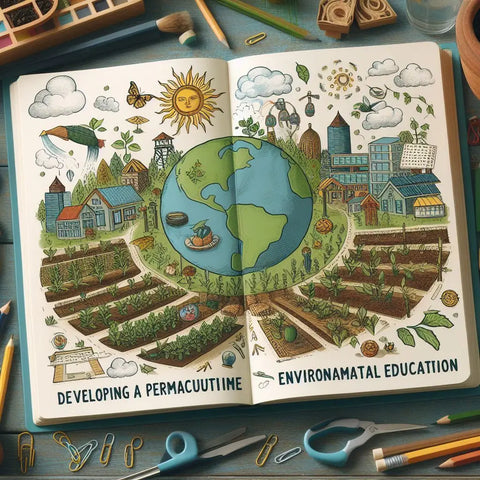
Homeschool soil science through permaculture
Homeschool soil science works especially well through permaculture because permaculture turns soil from an abstract “growing medium” into a living system students can observe, test, and improve. NRCS frames soil science as a practical, research-based field for understanding and conserving soil, while its soil-health guidance centers four core principles: maximize living roots, minimize disturbance, maximize soil cover, and maximize biodiversity. Those principles give homeschoolers a simple structure for teaching real soil science through garden-based work rather than detached memorization. (Natural Resources Conservation Service)
That makes permaculture a strong teaching lens because it links visible garden practices to underlying biology. Mulching becomes a lesson in temperature buffering and erosion control. Cover crops become a lesson in roots, carbon inputs, and microbial food webs. Compost becomes a lesson in decomposition and nutrient cycling. NRCS explicitly notes that healthy soils absorb and retain more water and are less prone to runoff and erosion, which helps students connect what they do on the surface with what happens below ground. (Natural Resources Conservation Service)
For homeschoolers, the most teachable sequence is usually observational first and technical second. Start by comparing a mulched bed with bare soil, a tilled patch with an undisturbed patch, or a diverse planting with a single-crop container. Then have students test infiltration, count soil organisms, compare moisture retention, track plant vigor, or journal temperature and texture changes over time. Texas A&M’s youth rainwater materials even include soil infiltration ring activities, which pair nicely with permaculture lessons on soil structure and water cycling. Soil Science Society of America’s Soils4Teachers database also provides K-12 soil activities that can be adapted into home-based labs and field notebooks. (Rainwater Harvesting)
What makes this approach especially useful is that it teaches systems thinking without needing to announce that in a pompous voice. Students can see that roots feed microbes, microbes help cycle nutrients, mulch protects habitat, and disturbance breaks structure. NRCS notes that living roots maintain the rhizosphere, where nutrient and water cycling are especially active, which gives students a concrete way to understand that soil is not inert dirt but a biological community. (Natural Resources Conservation Service)
A good homeschool soil-science unit through permaculture usually revolves around a few recurring questions: What does healthy soil look like? What changes when soil is left covered or uncovered? How does water move through different soils? What happens when diversity increases? Instead of racing toward perfect yields, students learn to observe patterns, run comparisons, and revise management over time. That is both good science and good permaculture, which is mildly annoying in how neatly it lines up. (Natural Resources Conservation Service)
Rainwater harvesting projects for students
Rainwater harvesting projects are one of the most effective ways to teach students that water systems are designed, not magical. Texas A&M AgriLife Extension has a dedicated youth education resource on rainwater harvesting with activities for grades K-12, 4-H, and Junior Master Gardener programs. Its activities include rainfall simulation, raindrop splash, soil infiltration measurements, a corrugated roof and gutter model, a plastic-sheet watershed activity, a one-gallon jug watering device, system components, rain barrels, and drip irrigation. That makes rainwater harvesting unusually good for student projects because it combines hydrology, engineering, weather, conservation, and practical design in one package. (Rainwater Harvesting)
The best student projects usually move from model to measurement to application. Younger students can build simple gutter-and-container demonstrations or compare runoff from bare versus covered surfaces. Older students can calculate roof catchment area, estimate how much water a storm could yield, measure infiltration rates, and design a small rain barrel, drip system, or wildlife-watering feature. Texas A&M’s materials explicitly frame these activities around water management and conservation, which makes them more than crafty plumbing with educational branding. (Rainwater Harvesting)
Rainwater harvesting also works well for climate and resilience education because it shows students how landscapes can either shed water wastefully or hold it more intelligently. A roof, a barrel, a garden bed, and a mulch layer become parts of one connected system. That systems view matters. Students are not just learning how to store water. They are learning catchment, flow, storage, overflow, and beneficial reuse. Texas A&M’s resource breaks those components out clearly as catchment area, conveyance, storage, treatment, and distribution, which gives projects a clean design framework. (Rainwater Harvesting)
For homeschoolers or mixed-age groups, the most durable projects are the ones with a visible outcome. A rain barrel feeding a pollinator bed, a drip line watering seedlings, or a small runoff-diversion model that reduces erosion gives students something they can monitor across weeks or seasons. That helps shift the lesson from “water conservation is good” to “this design changed how water behaves,” which is much more useful and a lot less preachy. (Rainwater Harvesting)
Permaculture ethics lessons for teens
Permaculture ethics lessons for teens work best when they are taught as tools for judgment, not slogans to chant near a compost pile. The Permaculture Association’s Children in Permaculture project describes education based on the three ethics of Earth Care, People Care, and Fair Share, while permacultureprinciples.com describes those ethics as the foundation for permaculture design. In other words, ethics come first because design choices are never only technical. They always involve tradeoffs about land, people, and resources. (Permaculture Association)
That makes permaculture ethics especially useful for teenagers, who are old enough to handle moral complexity and generally unimpressed by fake simplicity. Earth Care can open discussion about soil loss, biodiversity, water use, and climate impacts. People Care can examine labor, access to food, public space, and community wellbeing. Fair Share can push students to think about limits, waste, surplus, and who benefits from a system. Permaculture Association materials explicitly frame these ethics as holistic and cooperative education, and UNESCO’s Education for Sustainable Development work similarly emphasizes learning that equips young people to engage with sustainability in informed, action-oriented ways. (Permaculture Association)
For teens, the strongest lessons are case-based. Instead of asking whether they “believe in sustainability,” give them design dilemmas. Should a family prioritize a lush lawn or a rain garden during drought? Should a school garden donate surplus, sell it, or compost it? Is it ethical to plant a productive garden that excludes neighbors, or a shared garden that needs more coordination? These are good permaculture questions because they force students to apply Earth Care, People Care, and Fair Share together rather than treating each ethic like a separate poster on a wall. (Permaculture Principles)
Permaculture ethics also pair naturally with systems thinking, which current sustainability education increasingly treats as essential. UNESCO’s ESD framework and recent OECD climate-literacy materials both emphasize understanding interconnections and building the capacity to act. Permaculture ethics give teens a grounded way to do that. They ask not only how a system functions, but whether it distributes benefits and harms responsibly. That is a much better adolescent lesson than “recycle more and hope for the best,” which is roughly the moral sophistication of a cereal box. (UNESCO)
Done well, ethics lessons for teens should end in design, reflection, and action. Students might redesign a yard, compare food systems, debate neighborhood land use, or create a small project that visibly meets the three ethics. That keeps permaculture from becoming abstract philosophy with garden props. It becomes what it is supposed to be: a way of making decisions that ties ecology, community, and responsibility together. (Permaculture Principles)
Teacher guides for regenerative education
Teacher guides for regenerative education work best when they treat gardens, soil, water, and community as connected systems rather than isolated topics. KidsGardening’s educator materials are built around garden-based, inquiry-rich lessons and curriculum guides, while its broader resource library includes full programs, lesson plans, and implementation tools for youth garden learning. That makes regenerative education especially teachable because it can combine ecology, nutrition, climate, community, and stewardship in one place instead of pretending those subjects live in separate boxes. (KidsGardening - Helping Young Minds Grow)
A strong teacher guide usually gives educators three things: a practical way to start, standards-linked lesson ideas, and a sequence that moves from observation to action. KidsGardening’s curriculum catalog includes books and guides such as The Growing Classroom, Math in the Garden, and climate-focused facilitator materials, which shows how regenerative education can be structured across ages and subjects rather than treated as an extracurricular garnish. (KidsGardening - Helping Young Minds Grow)
The most useful regenerative teacher guides also frame the garden as a living lab, not a decoration near the playground. They support lessons on soil care, pollinators, compost, biodiversity, food systems, and climate resilience, while giving teachers enough scaffolding to run activities without needing to become full-time horticulturists through sheer panic. KidsGardening’s lesson-plan collection reflects that approach, with activities on compost, pollinators, biodiversity, no-till, and youth mentoring. (KidsGardening - Helping Young Minds Grow)
For schools or programs building from scratch, the best guides also include program design and sustainability, not just lesson ideas. KidsGardening’s Seeds of Success Toolkit was developed to support edible youth garden programs and is explicitly designed to explain the who, what, where, why, when, and how of sustaining them. That matters because regenerative education collapses quickly when the pedagogy is lovely but nobody planned for soil, volunteers, materials, or regular use. (KidsGardening - Helping Young Minds Grow)
Community garden learning for youth programs
Community garden learning is especially strong in youth programs because it connects practical work with service, leadership, and food literacy. KidsGardening’s Seeds of Success materials describe youth garden clubs and service-learning projects as ways for young people to address community needs, contribute to local food supply, and build social awareness through garden work. That is a much sturdier educational model than treating youth gardening as a few cute planting activities followed by total institutional amnesia. (KidsGardening - Helping Young Minds Grow)
The educational power of community gardens comes from the mix of responsibility and relevance. KidsGardening’s youth-garden toolkit describes youth gardens as spaces designed to help young people learn about plants, connect to nature, and participate in the full process from planting to harvest, with formats ranging from containers and raised beds to pollinator gardens and food gardens. In community-based programs, that means the garden can become a site for environmental learning, teamwork, public service, and even neighborhood food support all at once. (KidsGardening - Helping Young Minds Grow)
The strongest youth programs also build in reflection and civic context. Cornell’s Project Seeds of Wonder, highlighted by KidsGardening, is aimed at ages 13 to 19 and is organized around themes such as cultivating community, curiosity, gratitude, and resilience. It uses hands-on activities, project-based learning, reflection, discussion, and field trips to help youth connect gardening to place, food systems, and belonging. (KidsGardening - Helping Young Minds Grow)
That broader frame matters because community garden learning should not stop at “how to grow a tomato.” It should also teach why food access, stewardship, reciprocity, and local care matter. The best youth programs use the garden as a community classroom where participants learn growing skills, but also learn to notice who benefits, who is excluded, and how shared land can serve a neighborhood. Apparently a patch of beans can carry more civic education than some official curricula. (KidsGardening - Helping Young Minds Grow)
School biodiversity observation worksheets
School biodiversity observation worksheets work best when they train students to notice, record, compare, and question what they find, instead of just filling blanks next to the word “butterfly.” A good worksheet usually prompts students to document habitat, species type, behavior, weather, abundance, and distinguishing features, then compare observations across places or times. iNaturalist’s educator guidance emphasizes that students should make useful observations by taking identifiable photos, recording multiple angles or features, and distinguishing wild organisms from cultivated ones. (iNaturalist)
That guidance translates neatly into worksheet design. A school biodiversity sheet can ask students to record where an organism was found, whether it was wild or planted, what it was doing, what nearby habitat features were present, and what evidence supports the identification. The archived iNaturalist teacher guide also recommends sketching, field guides, and hands-on exploration for elementary and middle school students, which makes worksheets especially useful as screen-free observation tools before or alongside digital uploads. (iNaturalist)
For school gardens, the best biodiversity worksheets are usually organized around recurring questions: What kinds of organisms are here? Which plants attract the most insects? How does biodiversity differ between a mulched bed, a lawn edge, and a pollinator patch? KidsGardening’s lesson-plan collection includes biodiversity-related activities such as Phenomenal Pollinators, Bugs in Balance, and Support Biodiversity by Starting a Seed Library, which fit well with observation sheets that guide students to look for patterns instead of isolated sightings. (KidsGardening - Helping Young Minds Grow)
In practice, a useful worksheet should include simple fields such as date, location, weather, species or group observed, plant association, behavior, evidence collected, and follow-up questions. That structure helps students do real ecological noticing at a school scale. Which is refreshing, because most worksheets are designed mainly to kill time with clip art and mild despair.
Related collection
Explore Related Collections
Browse culinary and botanical collections related to this topic.
Browse Ingredient CollectionsProducts and collections are presented for general ingredient, culinary, botanical, craft, or gardening use. Content on this site is educational only and is not medical advice.
Leave a comment